
CAIBI ASSESSMENT

Split-Flap Display

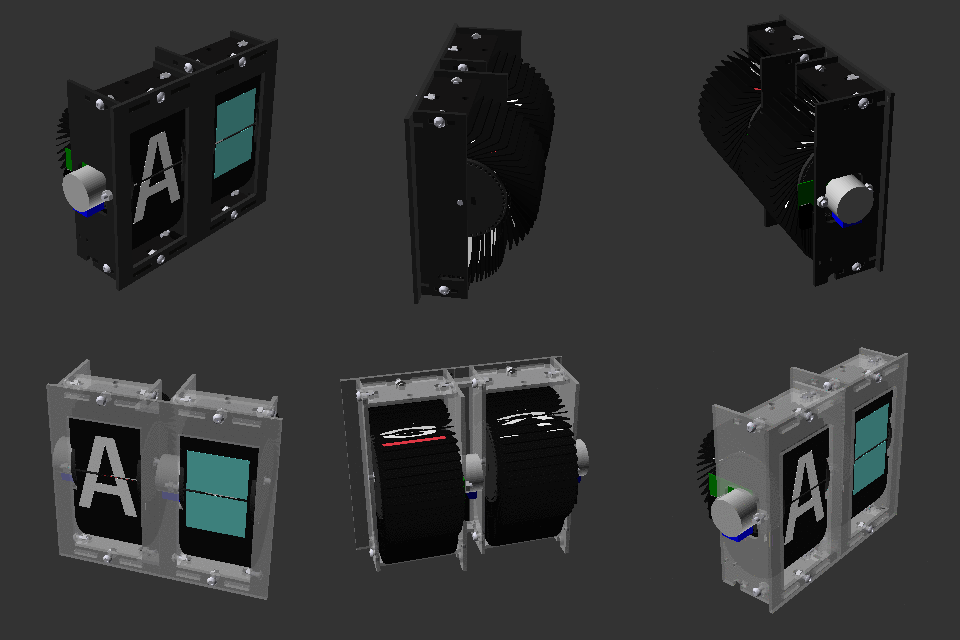
A modular ESP32-based split-flap display designed to scale from a single character to large installations.

CAIBI VERDICTBUILD FOR THE EXPERIENCE

A physical display with sound, motion and presence that software cannot reproduce. It makes most sense when the mechanism itself is part of the appeal.

AI CAN HELP

Useful work to hand to AI

  • Firmware help
  • Layout calculations
  • Debugging
AI CAN'T DO

The physical boundary

  • Fabricate the repeated mechanical parts
  • Assemble and wire every display module
  • Fix mechanical alignment, friction and sensor positioning problems
  • Calibrate a large bank of modules so they behave consistently
BUILD WITH AI

Start with the project, not a blank prompt.

The CAIBI build pack gives an AI assistant the source, the known constraints, the useful AI work and the physical boundary. It is designed to help you move faster without pretending the AI has built the thing for you.

Preview the full build brief
I want to build Split-Flap Display.

Source project: https://github.com/scottbez1/splitflap

Use the source as the authority. Do not invent parts, dimensions, prices or capabilities that are not published.

AI can help with: Firmware help, Layout calculations, Debugging.
AI cannot physically do: Fabricate the repeated mechanical parts, Assemble and wire every display module, Fix mechanical alignment, friction and sensor positioning problems, Calibrate a large bank of modules so they behave consistently.
Tools and capabilities involved: Laser cutting, Soldering.
CAIBI's main concern: Every extra module multiplies fabrication, assembly, calibration and fault-finding work.

Start by checking the source, confirming the current parts and build instructions, then give me a staged plan. Clearly separate source facts from your suggestions. Stop and ask me to verify anything that depends on physical fit, wiring, calibration or safety.
THE BUILD

How it actually comes together

Check the source ↗
01
YOU

Choose the display size

Decide how many modules you actually need before ordering or fabricating parts. Every added character multiplies mechanical and electronics work.

02
YOU

Use a stable release

Start from the published stable v2 mechanical release rather than the auto-generated development artifacts unless you specifically want to experiment.

03
YOU

Fabricate the mechanics

Laser cut the enclosure and module parts, prepare the flap sets and assemble each mechanism.

04
YOU

Build the electronics

Assemble the sensor and driver electronics, connect motors and chain modules using the documented architecture.

05
AI + YOU

Configure and calibrate

Load the firmware, verify sensing and use software calibration. AI can help with configuration, scripts and fault finding.

06
AI + YOU

Integrate your content

Connect the finished display to the data, messages or automation you want it to show.

WHAT YOU NEED

Key components

  • Laser cut 3mm MDF or acrylic mechanical parts
  • Printed flap set, 52 flap v2 option recommended
  • Sensor PCB for each module
  • Chainlink driver electronics
  • ESP32 based controller route
  • Motors, magnets, fasteners and wiring for each module
AFTER THE FIRST BUILD

Ways to take it further

40 or 52 flap modulesCustom flap fonts and symbolsSingle or multi-row displaysCustom combined front panelsDifferent enclosure materials
OTHER WAYS TO GET THERE

You do not have to follow one route.

MADE BY PEOPLE

Real builds belong here.

No reviewed builder listings yet

When people submit completed builds, this section can link to their build notes, repo, printable files, shop or finished version. CAIBI does not take payment or insert itself into the sale.

Add your build or listing
SOURCE · CAIBI · BUILDERS

What supports the verdict

SOURCEScott Bezek

Source available with a stable v2 mechanical release

  • The project is modular and can scale from a single character to large displays.
  • The v2 mechanical and sensor design is the recommended route for new builds.
  • The project publishes stable releases, ordering guides, assembly instructions, electronics documentation and an interactive 3D model.
  • Mechanical parts are based on laser cut sheet material and the design is parametric in OpenSCAD.
Open source ↗
CAIBIBUILD FOR THE EXPERIENCE

A physical display with sound, motion and presence that software cannot reproduce. It makes most sense when the mechanism itself is part of the appeal.

Evidence
Strong
Biggest challenge
Every extra module multiplies fabrication, assembly, calibration and fault-finding work.
BUILDERSNo published reports yet

Actual time, cost, changes and outcomes from reviewed builds will appear here.

Add your build report ↓
BUILT IT?

Tell us what actually happened.

Your result can improve the assessment and, if you choose, link people to your public build or listing.

  • What worked and what changed
  • Actual time and cost
  • Public build or repo link
  • Optional maker or sales listing