Compare the documented build with the purchase reference.
Build it yourself
Known parts cost£2,565Build total not establishedSelf-sourced hardware allowance; bed, taxes and fabrication extra
Time
About 2.5 hours for current v1.8 kit assembly after the supporting infrastructure is ready. From-scratch manufacture and sourcing is a separate, much larger job.
Difficulty
5/5
Physical processes
Mechanical assembly · Raised-bed construction · Electrical setup · Water connection · 3D printing or machining for a scratch build
Prices are not directly comparableWhat the prices cover
The exact v1.8 BOM totals $2,889.39 of item prices and FarmBot says self-sourcers might expect to pay about 20% more for components than the table indicates. CAIBI applies that source-stated allowance and uses the dated FX snapshot for the approximate GBP display. This is still not an all-in build total.
Not included: Raised bed and soil; Shipping, taxes, duties and import fees; Minimum-order waste beyond the rough source allowance; Fabrication tools or subcontracting; Research and build labour; DIY technical support.
Build evidence recorded 5 Sep 2026. Currency conversions are approximate.
The exact v1.8 BOM totals $2,889.39 of item prices and FarmBot says self-sourcers might expect about 20% more, producing a source-guided baseline of about $3,467 / £2,565 before several exclusions. The complete v1.8 kit is $5,995 / about £4,435 before UK import taxes and duties, but it also includes factory pre-assembly, a matched parts set and support. Raised-bed infrastructure, DIY fabrication, labour, import costs and support differences remain decision-critical, so CAIBI does not publish the nominal gap as a saving.
Four NEMA 17 stepper motors with rotary encoders and GT2 drivetrain
03
Farmduino controller
04
Universal Tool Mount and two 3-slot toolbays
05
Seed injector
06
IP67 USB camera
07
Water and vacuum tubing
08
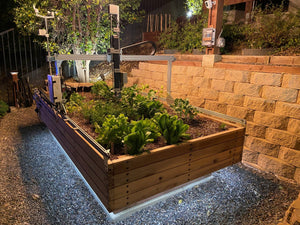
Raised bed or equivalent supporting structure
Full source specifications
Genesis v1.8 aluminum tracks, gantry and Z-axis structure
Four NEMA 17 stepper motors with rotary encoders and GT2 drivetrain
Farmduino controller, Raspberry Pi 4, power supply, electronics enclosure and wiring
Universal Tool Mount and two 3-slot toolbays
Seed injector, watering nozzle, soil sensor and rotary tool
IP67 USB camera
Water and vacuum tubing, solenoid valve and vacuum pump
Raised bed or equivalent supporting structure, soil, electricity, water supply and internet provided separately by the builder
TOOLS / PROCESSES5 involved
Mechanical assembly
Raised-bed construction
Electrical setup
Water connection
3D printing or machining for a scratch build
The real-world workYOU STILL HAVE TOThe real-world work
Choose whether to buy the supported kit or manufacture and source the machine yourself
Build or prepare a straight, rigid and level raised bed or equivalent support
Provide safe mains power, the correct plug or adapter, water and reliable internet
Fabricate and inspect parts if following the from-scratch route
Assemble and physically align the tracks, gantry, Z-axis, cables, tubing and tools
Commission motors, sensors, water delivery, tool changing and emergency stopping on the real machine
Keep people clear of pinch, entanglement and rotary-tool hazards
Verify that unattended watering and movement are safe for the actual garden
THE BUILD SEQUENCE
How it comes together
1Preparation
Choose kit or from-scratch before buying anything
Use the current v1.8 BOM and complete-kit page as two different routes. The BOM price table is not an all-in self-build quote, and the complete kit includes factory pre-assembly, support and a known matched set of parts.
AI + YOU
Prepare the supporting infrastructure
Build or verify the raised bed or equivalent structure first. It must be rigid, straight and level enough for the X-axis tracks, with suitable access to mains power, water and reliable internet. The official 2.5-hour kit assembly estimate starts after this work is complete.
YOU
Manufacture and source parts if going DIY
For a scratch build, work through the exact v1.8 CAD, BOM and manufacturing documentation, decide what will be printed, machined, bought or subcontracted, and inspect the resulting parts. AI can organise the package, but it cannot certify dimensions or fabrication quality from a parts list.
AI + YOU
2Build and assembly
Assemble tracks, gantry and Z-axis
Follow the current v1.8 written instructions, keeping the track geometry and wheel adjustment physically consistent. The source still points to a v1.7 assembly video for general guidance, so the v1.8 written documentation wins where details differ.
YOU
Connect cables, tubing and electronics
Install the cable carriers, water and vacuum tubing, electronics box, Farmduino, Raspberry Pi, motors and sensors. Keep water routing and mains-power arrangements physically safe and use the source-recommended protected outlet setup.
YOU
Install and prove the tool system
Set up the UTM, seed injector, watering nozzle, soil sensor, rotary tool and camera. Verify tool pickup, hose connections and physical clearances before building automated sequences around them.
YOU
3Configure and test
Configure software and calibrate the real machine
Bring the FarmBot web app and device online, then verify axis movement, homing, motor feedback, camera position and tool behaviour. AI can help interpret settings and logs, but calibration evidence must come from the machine.
AI + YOU
Prove safety before unattended operation
Test the physical E-stop, stopping behaviour, water control and movement around the actual bed. Keep clear of pinch and entanglement points and the rotary tool. Treat custom code and third-party integrations as changes that must be re-tested, especially where they can leave water running.
YOU
Automate only after the baseline works
Create planting, watering, sensing, imaging and maintenance sequences once the mechanical platform is reliable. Use AI for sequence logic, API work and analysis, then judge the actual plants, soil and weather rather than assuming automation is correct.
AI + YOU
Benchmark this project
Use the FarmBot Genesis v1.8 prompt. Compare what different models deliver, then add what happened when you tried it.
Compare the complete-kit and self-sourced routes without hiding exclusions
Explain assembly steps, wiring and configuration from the current documentation
Help write or review FarmBot sequences, API integrations and software changes
Interpret logs and configuration symptoms during troubleshooting
Help plan experiments and changes after the baseline machine is proven
CAIBI · AI CAN'T DO
You still need to
Choose whether to buy the supported kit or manufacture and source the machine yourself
Build or prepare a straight, rigid and level raised bed or equivalent support
Provide safe mains power, the correct plug or adapter, water and reliable internet
Fabricate and inspect parts if following the from-scratch route
Assemble and physically align the tracks, gantry, Z-axis, cables, tubing and tools
Commission motors, sensors, water delivery, tool changing and emergency stopping on the real machine
Keep people clear of pinch, entanglement and rotary-tool hazards
Verify that unattended watering and movement are safe for the actual garden
Original source AI use and prompts
SOURCEThe original project does not publish an AI prompt
The prompts below are CAIBI helpers for this build. They are not presented as instructions from the creator.
CAIBI STARTING PROMPTS
Copy a prompt for this build
Each prompt tells AI to keep the original project source as the reference and to flag anything you must verify on the real build.
Ways to take it furtherAFTER THE FIRST BUILD
Ways to take it further
Complete Genesis v1.8 kitFully self-sourced v1.8 buildCustom raised-bed dimensions within supported geometryCustom tools using the UTMSelf-hosted softwareCustom sequences and API integrations
Current Genesis v1.8 product, manufacturing, assembly and safety documentation is available and actively maintained. The exact v1.8 BOM publishes a $2,889.39 item-price subtotal and explicitly warns that self-sourcing may cost about 20% more before other exclusions. The current complete kit is $5,995 with free global shipping, but international customers remain responsible for import taxes, duties, fees and import management. The product page says 90% pre-assembled while the exact v1.8 assembly documentation says 95%; CAIBI preserves that source inconsistency rather than flattening it.
FarmBot is unusually open for a finished garden robot: the CAD, electronics, software and documentation are published, and the machine is designed to be changed. The complete kit is the rational route if the goal is to use a supported FarmBot. Building from the open files makes more sense when fabrication, modification and learning are part of the goal rather than when the only objective is cheaper automated watering.
Evidence: Strong
BUILDERSNo published reports yet
Actual time, cost, changes and outcomes appear here after submitted builds are reviewed.


 PAROL6 Desktop Robot Arm