

Build your own Stack-chan with a printed case
A proposed route to a printed desk robot with three expressions and limited pan/tilt motion. No CAIBI physical validation yet.
A staged completion guide and prompts. The parts and finished result still need physical validation.
Share your buildWhat you will work towards
Make an expressive desk robot, starting with a screen face and adding controlled head movement.
CAIBI’s proposed addition: Choose one documented core/PCB/servo/case combination, prove it on the bench, then print the matching enclosure. Personalise behaviour before adding voice services.
Guide version 1.0. AI can help explain, adapt and debug; you still measure, assemble and test the physical result.
Start with the original
Open hardware and software
- Open hardware and software · view source material ↗
- Case versions and assembly · view source material ↗
Source inspected 10 October 2026. Apache-2.0 repository provides firmware and printable case files. Case v0 and v1 use different boards and servo families; their components are not interchangeable. Some DIY combinations require firmware built from source; do not assume the browser installer supports every legacy case and servo route. Not built or assessed by CAIBI.
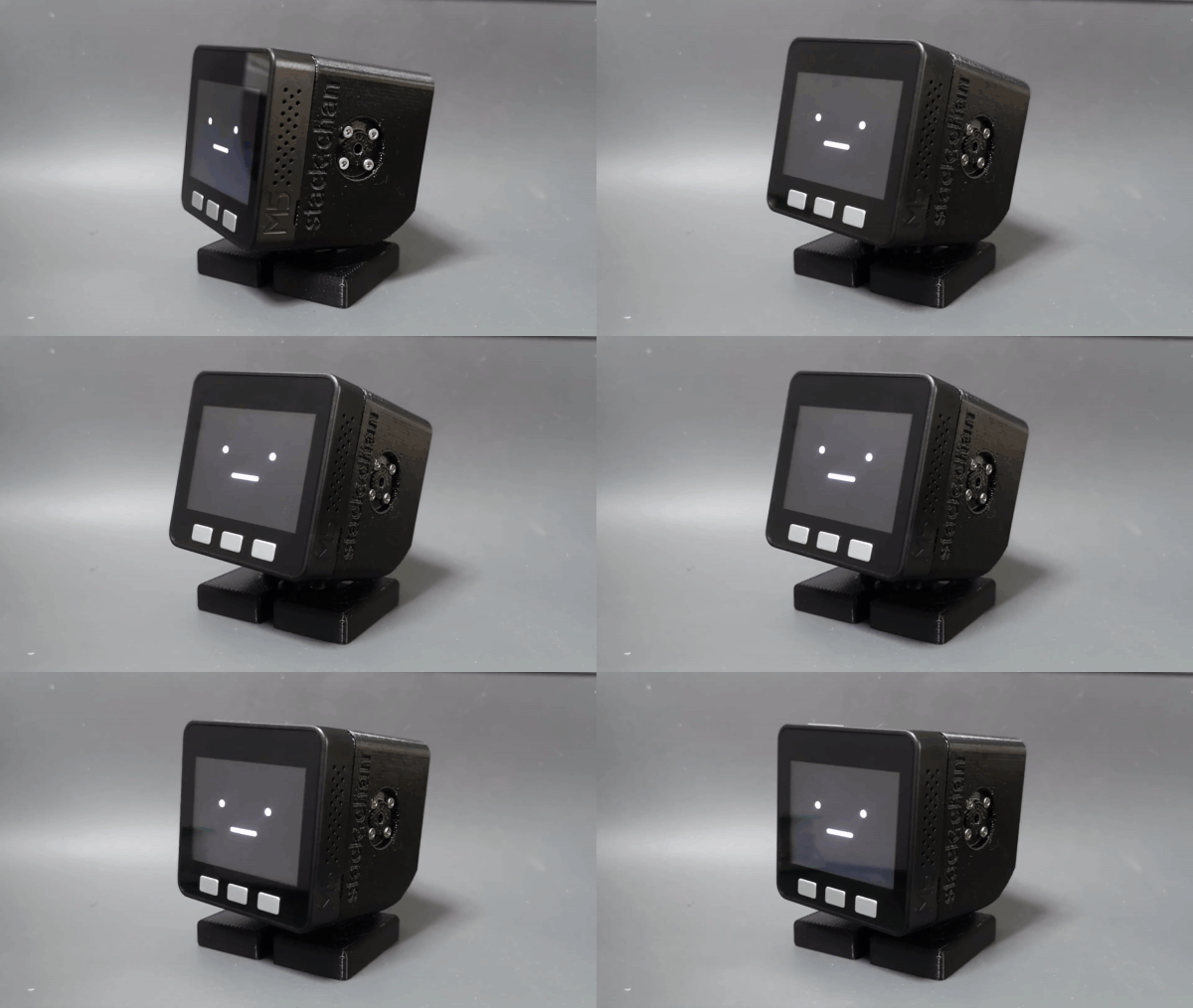
From source to something you can finish
What the source provides: An open robot platform with firmware, simulator and printable case variants.
What still needs doing: Select a matching hardware/firmware/case set; some DIY combinations need source-built firmware.
Your first milestone: Run three expressions in the simulator before adding physical motion.
Parts to confirm before buying
- One documented matching set of core, control PCB, servo models and case revision; record exact identifiers before purchasing
- Power arrangement specified for that exact hardware, compatible cables and fixings
- Matching printable files and a printer capable of their dimensions
Use the source wiring and bill of materials as the starting point. Confirm exact variants, availability, tools and complete cost before ordering.
The completion route
- Run a simple face in the simulator. Save a source revision and resolve the exact hardware combination.
- Prove the display and each actuator separately. Centre actuators before attaching horns; establish conservative movement limits.
- Print a small fit sample before the complete shell. Check cable travel, access to power and clearances through the permitted motion.
- Assemble and test a short local expression routine. Defer microphones, network access and paid voice services until this works.
Prompts to move it forward
Copy a prompt into your AI tool with the source material and your actual parts. Work through one small step at a time and check the output before using it. Choose an AI tool or practise the skills first.
Check the source before buying
Review the source material I supply for Build your own Stack-chan with a printed case. Make a table of what is provided, missing, contradictory or dependent on a paid service. Identify exact hardware revisions, firmware files, library versions, CAD files and licences. Separate creator claims from your proposed additions. Do not fill gaps with guessed specifications. Finish with one small test that can resolve the biggest uncertainty before I buy parts.

Sources:
Open hardware and software: https://github.com/stack-chan/stack-chan
Case versions and assembly: https://github.com/stack-chan/stack-chan/blob/develop/case/README.md
Plan the next step
Help me make a three-expression desk companion using the linked project. First request my exact core, PCB, servo models and pinned source version. Confirm the supported firmware target and produce one small change at a time. Start without cloud credentials. Add conservative motion limits and a clear stop state; do not invent pin assignments or claim a successful hardware test.

Sources:
Open hardware and software: https://github.com/stack-chan/stack-chan
Case versions and assembly: https://github.com/stack-chan/stack-chan/blob/develop/case/README.md
Design a measured enclosure
Use only the case variant matching my confirmed hardware. Ask for measurements and preserve functional servo mounts. Propose an original cosmetic shell change with removable access, cable clearance and a small fit coupon. Explain what must be checked physically before printing the whole case.

Sources:
Open hardware and software: https://github.com/stack-chan/stack-chan
Case versions and assembly: https://github.com/stack-chan/stack-chan/blob/develop/case/README.md
Check and document the result
Create a test log for Build your own Stack-chan with a printed case. Intended outcome: Make an expressive desk robot, starting with a screen face and adding controlled head movement. Separate expected behaviour from observed results. Include power restart, disconnected inputs, communication failure and the actual physical use. Ask me to provide results, firmware versions, changes, photos and unresolved problems. Never mark a test passed without my evidence.

Sources:
Open hardware and software: https://github.com/stack-chan/stack-chan
Case versions and assembly: https://github.com/stack-chan/stack-chan/blob/develop/case/README.md
What to test and record
- Check that each expression renders after restart.
- Check centring and limited motion for each axis before full assembly.
- Check the whole permitted motion for cable tension or collisions.
- Record behaviour on restart and lost connection; confirm an accessible power-off method.
Keep photos, exact parts and software versions with the test log. Failed or incomplete attempts are useful evidence too.
A possible next version
After a recorded successful build, try a focus timer or one read-only notification. Voice and tracking are separate extensions.
What builders are contributing
Suggest something useful, improve a route or share what you made. Contributions are reviewed before publication. Community builds remain attributed to their builders.
Loading reviewed contributions…