

RECENTLY CHECKED
All projects →
CAIBI ASSESSMENT

Precious Plastic Shredder 3.3

CAIBI VERDICTBUILD FOR THE EXPERIENCE

An open-source workshop machine that reduces sorted plastic waste into flakes for later recycling processes, with downloadable fabrication files and a documented safety-focused 3.3 revision.

Build or buy?

Compare the documented build with the purchase reference.

Build it yourself

Build estimate£650–£1,370CAIBI estimate · medium confidenceParts and local fabrication allowance; equipped workshop required
Time
1-2 weeks is the current source estimate for the Shredder small 3.3 build. That assumes access to, or subcontracting of, the required metalworking, machining and electrical work.
Difficulty
5/5
Physical processes
Grinder · Chop saw · MIG/MAG or TIG welder · Drill press · Lathe · Laser-cutting service or suitable metal-cutting equipment · Torque wrench · Bearing mounting tools · Electrical test equipment
See build requirements →

Purchase reference

Buy price referencePrice not checkedNo priced alternative recorded

Check the source for the exact model, availability and what is included.

Check comparison evidence →
Purchase comparison not yet priced
What the prices cover

Planning range for laser-cut steel, geared motor/drive, shaft/bearings, guarding and electrical hardware. Precious Plastic publishes the full BOM but not a stable global all-in 3.3 price; current comparable build estimates vary substantially by local fabrication.

Includes: Steel knife/frame fabrication; Geared motor/drive; Shaft/bearings/hardware; Hopper/stand/guarding; Electrical controls.

Not included: 40–100+ hours fabrication/debugging; Workshop machinery; Compliance/inspection costs; Shipping.

Build evidence recorded 4 Sep 2026. Currency conversions are approximate.

Small granulators and workshop shredders differ materially in motor power, guarding, duty cycle and output size. The current parts estimate is useful, but a single bought price would be misleading.

BUILD AT A GLANCE

Source view and main parts

Check the source ↗
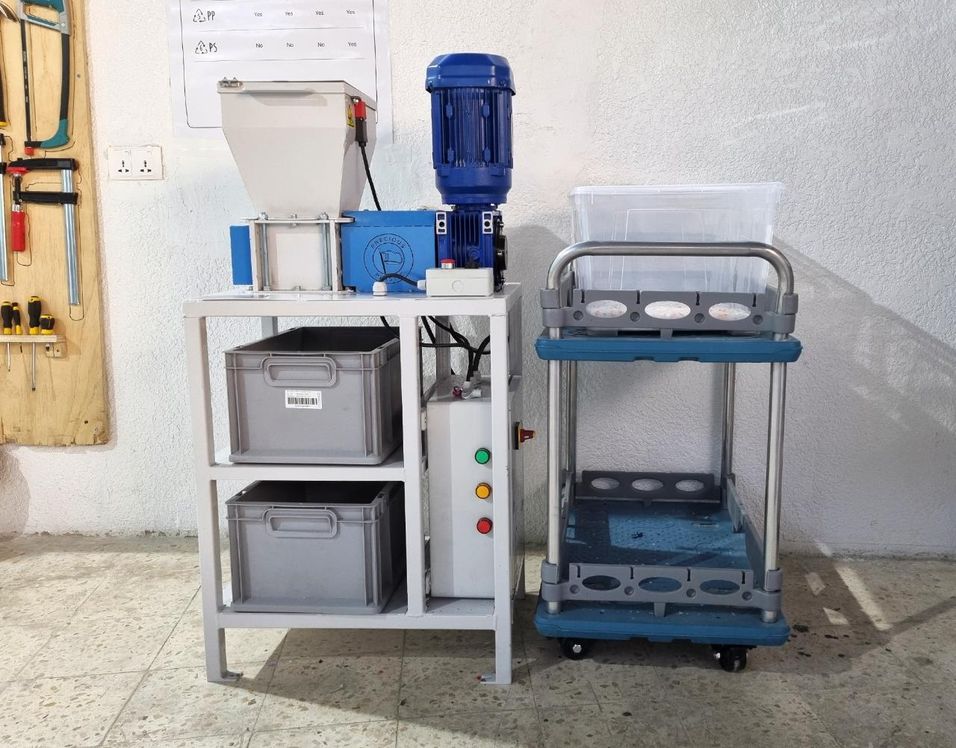
Shredder 3.3 build gallery photographShredder 3.3 build gallery photograph · Precious Plastic / One Army ↗
PHYSICAL BUILD6 key parts or groups
No.Source specification
01Shredder 3.3 laser-cut/machined metal parts and fasteners from the official BOM
02Shaft
03Fabricated steel frame and hopper/guarding components
04Geared electric motor and drive/coupling components specified for the chosen configuration
05Contactor
06Wiring
Full source specifications
  1. Shredder 3.3 laser-cut/machined metal parts and fasteners from the official BOM
  2. Shaft, knives/spacers and bearing assemblies from the source package
  3. Fabricated steel frame and hopper/guarding components
  4. Geared electric motor and drive/coupling components specified for the chosen configuration
  5. Contactor, overload protection, safety switching, emergency-stop/control hardware and enclosure components
  6. Wiring, terminals, protective earthing and other electrical hardware specified by the source/manual and local requirements
TOOLS / PROCESSES9 involved
  • Grinder
  • Chop saw
  • MIG/MAG or TIG welder
  • Drill press
  • Lathe
  • Laser-cutting service or suitable metal-cutting equipment
  • Torque wrench
  • Bearing mounting tools
  • Electrical test equipment
The real-world workYOU STILL HAVE TOThe real-world work
  • Decide whether you have the fabrication and electrical competence to build this machine at all
  • Source or subcontract the metal cutting, turning and welding
  • Select and install the correct motor, contactor, overload protection and controls
  • Fabricate and assemble the frame, shredder box, bearings, shaft and drive
  • Install and verify guards, safety switching and emergency-stop provisions
  • Inspect alignment, fasteners, electrical protection and rotation before commissioning
  • Read and follow the current operating manual and local machinery/electrical requirements
  • Operate only with suitable sorted plastics and keep hands/tools away from the cutting chamber
THE BUILD SEQUENCE

How it comes together

1Preparation

  1. Read the 3.3 package and operating manual before ordering

    Treat the CAD, DXF, blueprints, schematics, BOM and operating manual as one system. Identify which operations require a competent fabricator/electrician and which parts will be subcontracted before buying material.

    YOU
  2. Prepare the fabrication package

    Extract the correct revision files for laser cutting, turning and general metalwork. AI can help inventory drawings and flag apparent mismatches, but dimensions and revision choices must be verified against the official package.

    AI + YOU
  3. Fabricate and inspect the metal parts

    Cut, drill, turn and weld using appropriate workshop processes. Inspect critical shaft, bearing, knife, frame and mounting geometry before assembly rather than relying on visual fit alone.

    YOU

2Build and assembly

  1. Assemble and align the shredder mechanism

    Build the cutting box, shaft/knife stack, bearings and frame using the specified fasteners and torque/assembly methods. Confirm free movement and alignment without energising the drive.

    YOU
  2. Install drive, controls and protection

    Fit the motor/drive and have the contactor, overload protection, safety circuit, emergency stopping, enclosure and protective earthing implemented and checked by someone competent for the actual supply and local rules.

    YOU
  3. Verify guarding and fail-safe behaviour

    Before shredding material, inspect access to moving parts and verify the intended safety switching and stopping behaviour. Do not bypass guards or interlocks to make commissioning easier.

    YOU

3Configure and test

  1. Commission cautiously from the manual

    Use the current operating manual for rotation, start/stop, loading, jam response and maintenance checks. Stop on abnormal noise, movement, heat or electrical behaviour and resolve the cause before use.

    YOU
  2. Run it as part of a controlled recycling workflow

    Sort and prepare compatible plastic, control contamination, maintain the machine and store/process flakes appropriately. A shredder creates feedstock; it is not by itself a complete recycling process.

    YOU

Benchmark this project

Use the Precious Plastic Shredder 3.3 prompt. Compare what different models deliver, then add what happened when you tried it.

Try this benchmark
View the project prompt

CAIBI adaptation · Prompt 1.0 · Project source

Open and copy prompt →

Benchmark results 0

No reviewed results yet for Precious Plastic Shredder 3.3. Add the first result →

AI IN THIS PROJECT

Get AI help on this build

CAIBI · AI CAN HELP

AI can help with

  • Explain the supplied CAD, drawings, BOM and assembly sequence
  • Help organise fabrication packages for outsourced laser cutting or machining
  • Cross-check dimensions and documented tolerances against the source files
  • Help create inspection and commissioning checklists from the official manual
  • Troubleshoot non-safety-critical assembly observations against the documentation
CAIBI · AI CAN'T DO

You still need to

  • Decide whether you have the fabrication and electrical competence to build this machine at all
  • Source or subcontract the metal cutting, turning and welding
  • Select and install the correct motor, contactor, overload protection and controls
  • Fabricate and assemble the frame, shredder box, bearings, shaft and drive
  • Install and verify guards, safety switching and emergency-stop provisions
  • Inspect alignment, fasteners, electrical protection and rotation before commissioning
  • Read and follow the current operating manual and local machinery/electrical requirements
  • Operate only with suitable sorted plastics and keep hands/tools away from the cutting chamber
Original source AI use and prompts
SOURCEThe original project does not publish an AI prompt

The prompts below are CAIBI helpers for this build. They are not presented as instructions from the creator.

CAIBI STARTING PROMPTS

Copy a prompt for this build

Each prompt tells AI to keep the original project source as the reference and to flag anything you must verify on the real build.

Ways to take it further
AFTER THE FIRST BUILD

Ways to take it further

Standard Shredder small 3.3Subcontracted fabrication with local final assemblyBike-powered derivative using the standard 3.3 shredder boxWorkspace-scale installation feeding later extrusion/injection/sheet processes
More routes and resources
OTHER WAYS TO GET THERE

You do not have to follow one route.

REVIEWED RESOURCES

Useful places beyond the main source

SOURCE · CAIBI · BUILDERS

What supports the verdict

SOURCEPrecious Plastic / One Army

The current Precious Plastic library still publishes Shredder small 3.3 as the latest Basic/small revision, with downloadable manufacturing files, a BOM, schematics, stated skills/tooling, a 1-2 week build estimate and a separate operating manual. The page says this revision addresses safety and transportability by following CE safety requirements. Independent builders document physical PP 3.3-based machines. CAIBI has not fabricated, electrically commissioned or safety-certified this machine.

Open source ↗
CAIBIBUILD FOR THE EXPERIENCE

This is workshop infrastructure rather than a casual maker project. It makes sense for a person or group that actually intends to process a recurring stream of suitable plastic and values an open, repairable machine. AI can help interpret drawings, organise the BOM, explain assembly order and reason about documented tolerances, but it does not make the fabrication or operation safe.

Evidence: Strong

Leave a build review
HAVE YOU MADE THIS?

Leave a build review.

First-hand evidence improves the assessment
What we want to know

What happened when you actually tried to make it.

  • Did it work?
  • Actual time and cost
  • What did you change?
  • What was harder than the source suggested?
  • Would you build it again?